
Now let's deconstruct secularism
We've spent a decade talking about the deconstruction of Christianity— can we deconstruct secularism next? The task is far easier and much better for society. In fact, it might already be happening.

This “Cut for Time” post is material that didn’t fully make it into the final version of my sermon, “Let Not Your Hearts Be Troubled: The Trinity and a Crisis of Meaning.”
The Modern West has spent the last century or so without God as a primary reference point. This is often called “secularism.” When God is not the primary reference point for common life, something has to fill that void. As God has gone away, a kind of mechanistic materialism has come in: life, we think, is best explained through that which can be measured and observed, or whatever can be commodified and purchased. Western life revolves around science and capitalism, around physicality and commodified products.
So while we may be “disenchanted” with the God of the Bible, we’re fully enchanted with our two-day Prime delivery and streaming platforms and that allow us to call upon any number of items we desire and bring terabytes of content to our immediate attention within seconds like the spoiled little princes we are.
We also marvel at psychological analysis, quantum mechanics, crystals, family systems theory, astrology, anxiety science, and insights into human cognition for how we might maximize our sleep patterns, optimize our diet, or increase emotional health. Those who say secularism is all “disenchantment” are missing just how amazed people are at the magic of capitalism and science. Just listen to how people talk about AI or how their algorithm knows them or how they think their phone “knows” what they want or listens to their conversations. It’s not interest, it’s awe. The world has not been “disenchanted;” it’s been “misenchanted.”1
The view from above
But because we’re not enchanted with God, the cultural view of Christianity has come from a critical vantage point. Now, we are the mighty Third Person Narrator. We view faith not from the inside, or even from any space of familiarity. We instead view God and the Bible from a place of estrangement—a critical vantage from above the faith, not an intimate familiarity within it.
In theology, the critical vantage point places the reader of Scripture like a scientist viewing an experiment, except this “experiment” is the Alpha and Omega, the King of the Cosmos, the Husband of all humankind. All we do when we “deconstruct” is announce a power we think we possess and swear God doesn’t have (the ability to create meaning and critique it). We put God on the therapist’s couch and assess his words, offering our interpretation, doing precisely what Scripture tells us human beings cannot do in our nature:
“Who can fathom the Spirit of the Lord,
or instruct the Lord as his counselor?
Whom did the Lord consult to enlighten him,
and who taught him the right way?
Who was it that taught him knowledge,
or showed him the path of understanding?”-Isaiah 40:13-14
We love instructing the Almighty on who He is and is not. See, we never had a problem with “authority” or power that God claimed in life; we were just so in love with it we wanted to possess all of it. Gone are the days where reverence is any part of philosophy; fear has no place in our pursuit of wisdom. We’re the kings and queens now. We can tear down these castles of doctrine without trembling because our sense of “self” has become aggrandized to the point of lunacy. But Christianity simply cannot be “viewed” from above. Without humility, no man or woman will ever know what God is like.
The “deconstruction” phenomenon of the past decade has swept through Protestant and Catholic circles alike. A lot of deconstruction was and is childish, but much of it was and is wonderful pruning and revealing of the state of the American Church. Ultimately, I thank God for the ways the cultural phenomenon of deconstruction has clarified Christianity, even if it has led to dwindling numbers and a proliferation and ego-stroking Instagram Reels. We will probably find this as a net-win. Pruning usually leads to growth.
Many deconstructionists make the claim that they are “just doing as they were taught.” In other words, they were told to read their Bible, so they started reading their Bible only to see that the very promises made to them by their parents’ generation are simply not there.
In the same manner, a lot of forms of deconstruction include looking at the promises made by a previous generation and just never seeing them pay out. A generation was given a vision of purity that involved shame and secrecy—it never paid out what the grownups told them it would. When a life of shame a secrecy only paid out in addictions, depression, and suicide, it was time not to kiss dating goodbye, but Christianity. It totally makes sense. This twisted version of Christianity was giving false promises all along, and when a generation saw them for what they were, they bounced.
But Bad Christianity isn’t the only thing unable to deliver on its promises.
Deconstructing Secularism
Gen Z is now showing us how to deconstruct not Christianity, but secularism. Broadly speaking, secularism (as mentioned above) is life with no reference point to God. It’s living in a world where God is strictly optional, completely unnecessary, and mostly ignored. Secularism says, “You do not need God to live a good life” and your best bet towards a good life would exclude him from your vision of reality.
Gen X and their kids were sold “The Secularization Hypothesis”: the world will improve and get better as we eliminate faith and theological commitments and embrace Enlightenment philosophy, science, and psychology. Alongside of this, the insane growth of our consumer goods made its way into our psyche. A mechanical and materialist vision of life was adopted hook, line, and sinker: this is the only world that exists now. To secularized people, there is no heaven, and God (if he exists) is a non-physical, amorphous being that somewhat animates the universe and give “peace.” Don’t give too much thought to him, if he’s even real in the first place.
To satiate our secular worship, we brought in technology (social media and smartphones), media (streaming endless options of content, podcasts, music, and prestige TV shows), political action (BLM, Vaccine wars, January 6th, violent and peaceful protest), cultural-political allegiances (book banning, college campus free speech fights, full sexual freedom, and extreme rhetoric of the conservative and liberal stripe) in the space where God used to exist. Identity formation moved from a communal quest (“my parents/community tell me who I am”) or a religious one (“God/divine action tells me who I am”) to an individualized conquest (“I am the only one who can tell the world who I am—and I must”). This story has been told before.
But here’s what is happening now: none of these things are working. Peter Berger, the renowned sociologist, said before he died: “The Secularization Hypothesis has failed” its own test. It has not delivered on its promises. And this was in 2016…Berger didn’t even see much of the last eight years. He died in 2019.
If we are going to listen to the promises of a secular world, we are now able to see that very world fail to deliver on its own promises. It’s been about 70 or so years into the great Secularization Hypothesis. They told us life would be better through a life enchanted by the material, the physical, and the human. They told us to find ourselves, to create identity through a brand-named, market-driven, algorithm-organized life, and worst of all: they told us we would be happy. But we’re miserable, depressed, anxious, and violent.
Don’t get me wrong: I have zero—zero—interest in “returning” to a pre-secularized world. It was its own nightmare. I don’t want to go back, I want to go forward, into a new world where secularism is seen for the hoax that it is and the gospel of Jesus Christ is heard anew.
The tide turning
That could be the moment we are in. Only now are we seeing a strange shift in the tide of people coming back to God. In his podcast and writing under the title, The Surprising Rebirth of Belief in God, Justin Brierley is showing us the turning tide. A bizarre surge in church attendance in the UK and in Nordic countries should alert Western Christians to be encouraged. The decline might be shifting; it certainly has globally, but now it might be happening in the West.
“Anybody with a graph can see that, globally, the brute numbers favour religion,” specifically Christianity. That’s James Marriott in The Times London back in May. And he’s right. But for as much as we see and talk about this global rise of Christianity, we forget that, in the West, secular liberalism is simultaneously failing. This is because as Marriott continues, “secular liberalism is superb at attracting converts (all those delicious freedoms) but inept at reproducing itself…” He gives a stark conclusion: “The world is not as secular as it seems.”
His own neighborhood in London serves as an example, he says, as the Anglican Church is experiencing wind in their sails as the Secularization Hypothesis keeps failing its own test:
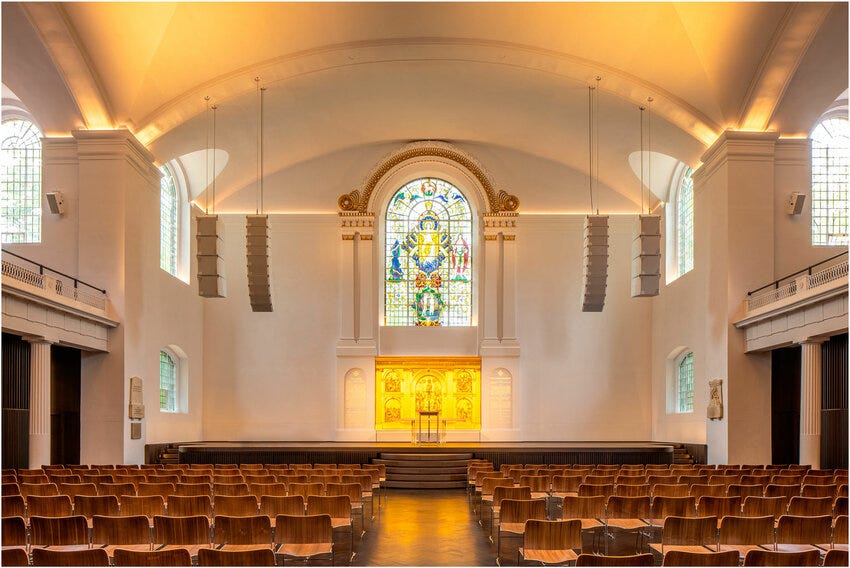
“For a long time I was in the habit of mourning the fate of my local church, St John at Hackney, when passing by on my evening walks. In the pale springtime twilight, its vast sides of yellow London brick and towering classical portico present an image of helpless, melancholy gigantism — a great ship of faith stranded out of time in a profane century.
Recently I walked past for the first time on a Sunday morning and, hearing a clamour, strayed inside to witness a huge, jubilant service. I had believed I was contemplating a ghost of the past; perhaps it was a vision of the future.”
We deconstructed Christianity and the pruning is leading to a worldwide revival. Something is coming up from the grave we swear we put it in. Much like the life of Christ, the faith of the Apostles seems to have only flourished in light of our apparent dismantling of it. But the deconstruction of secularism will work differently, I think. It will be easier and there will be nothing left after it is torn down—maybe only a history to tell. Because, unlike the Christian gospel, secularism is not only unable to reproduce itself, it can’t resurrect either.
This is foundational to the argument made by Eugene McCarraher in his book, The Enchantments of Mammon: How Capitalism Became the Religion of Modernity (Belknap Press, 2019).
Yowza! I could hear the passion from the pulpit on this one! With Michelle shouting “amen” from the front row.